Chinese Scientists Teleported A Particle To Space

Image result for chinese scientists successfully teleported a particle to space
A team of Chinese scientists has successfully teleported a particle to a satellite in space.
As Time reports, the scientists sent a photon nearly 300 miles to a satellite orbiting Earth, which is the farthest recorded distance for quantum teleportation trials thus far. The Tibetan team had been teleporting scores of photons up from their laboratory for roughly a month, of which 900 trials were successful.
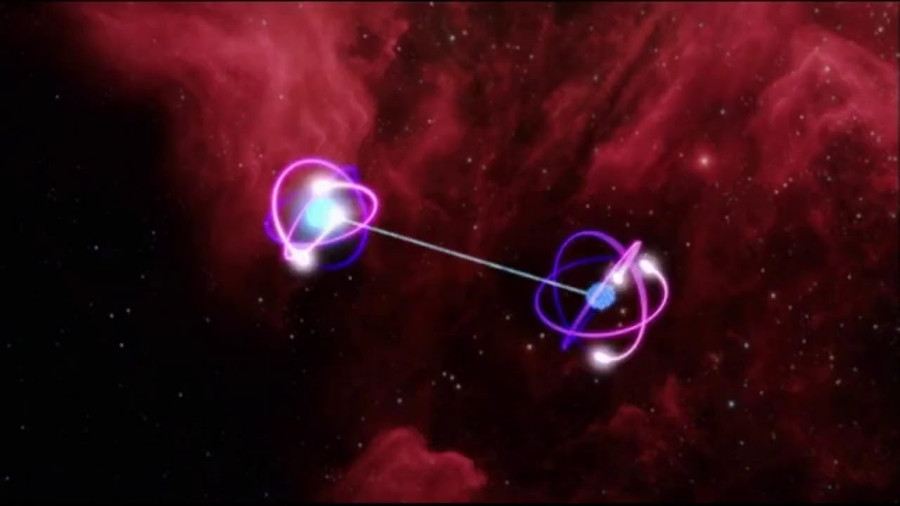
Although quantum teleportation may sound like something out of a science-fiction film, the science behind the process is far from fiction. In fact, the entire process is based around the idea that quantum information— i.e. the state of an atom, photon or other particle— can be transmitted from one location to another by means of entangled communications between the sending and receiving locations.
Though the first successful quantum teleportation experiment occurred only a year ago, this latest success prompts many in the field of quantum physics and teleportation to believe that this could open the door for more advancements and achievements to be made— including some that could make a globally-accessible quantum-transmitted Internet service possible.
Top photo courtesy of Skye D./Flickr, CC BY-ND 2.0
Natalie Wickstrom is a freelance writer based in Athens, Georgia. She most likely wrote this piece to the tune of a movie score whilst chewing gum.


The Storied History of the Spooky Physics Behind China’s Teleportation Success

Image result for At the heart of the history of quantum entanglement lies a famous debate between two groups of physicists, a clever paradox and an iconoclastic way out of it.

At the heart of the history of quantum entanglement lies a famous debate between two groups of physicists, a clever paradox and an iconoclastic way out of it.

God does not play dice with the universe. He plays an ineffable game of his own devising, which might be compared, from the perspective of any of the other players, to being involved in an obscure and complex version of poker in a pitch dark room, with blank cards, for infinite stakes, with a dealer who won’t tell you the rules, and who smiles all the time.
– Terry Pratchett
In June 2017, a group of scientists in China announced that they had used the country’s Micius satellite, launched a year earlier, to teleport information from Earth to space in an instant. In other words, they had moved it across over 500 km in literally no time. To achieve this, they had relied on a natural phenomenon called quantum entanglement. The name itself correctly suggests that it belongs in the realm of quantum mechanics, the realm of subatomic particles. The Chinese scientists’ experiment had bested a previous record, when in 2012 their leader himself had lead a team that had teleported information across 97 km.
Very few ideas in science enjoy the popularity that teleportation does: it has been equally awe-inspiring among scientists and laypeople. To the more inspired, what is fascinating is not how an object “leaves” one point in space and “arrives” at another but that it traverses the intervening distance in an instant. The implications of such travel are significant at first sight. The day when we will be able to “beam” a person up and down across space – a la Star Trek – might still be very far away but in the meantime we could use quantum entanglement to, for example, teleport digital security keys between two computers and prevent most forms of eavesdropping by hackers.
In the earlier experiment, Jian-Wei Pan, a physics professor at the University of Science and Technology of China, Hefei, and his colleagues used quantum entanglement to teleport information across Qinghai Lake in the country’s west. Using an ultraviolet laser pointed at a barium crystal, Pan’s team generated pairs of entangled photons. Each photon of a pair was transmitted using a telescope to two parties on either sides of the lake.
The nature of quantum entanglement
Let’s call the parties A and B.
Making a measurement on the photons yields a good description of the state the photons are in. It refers to the values of a few fixed variables. If the variables have a particular combination of values, then the system is said to be in a particular state. States are usually independent of extrinsic properties like mass. So, A’s and B’s goals are to see if a third party interacting with these photons ends up in a state similar to the control group even when separated by 97 km of free-space.
To measure this, the researchers at A let photons generated locally – i.e. at A itself – to interact with the incoming modified photons in a fixed, predictable way. This changed state is then measured and compared with the state of the photons at B. Pan & co. found that the states of the modified photons at A and those of the unmodified photons at B were the same 80% of the time.
What is wonderful is that the particles didn’t have to end up with the same state. Eighty per cent is a value large enough to rule out any coincidence. This long-distance “communication” between minuscule, fragile particles is proof that their pre-travel entanglement was durable and resulted in a predictability of state that let the particles behave similarly in two very different measurement experiments.
The precise nature of this entanglement, which Albert Einstein called “spooky action at a distance”, that baffles most scientists. When two groups of photons are said to be quantum-entangled, it means that the states that the groups are in are related to each other by means of a variable. If the variable changes, then the properties of the photons change, too. However, how the groups themselves are related to each other does not change.
The existence of this variable is not as much disputed as it is hoped into existence. We haven’t found it yet – assuming it exists. And because it remains outside the realm of human control, experiments with teleportation tend to leave this variable alone and instead focus on how much the measurement sites can be separated by, how efficiently large molecules can be entangled, etc. That is, they stick to testing its limits.
To do this, the photons are subjected to a simplified treatment, one conceived with the fewest assumptions as well as the fewest sources of error. Instead of groups of photons, physicists address them two at a time. The state that each half of this pair can exist is in is defined thus. Let’s say the two particles are ‘a’ and ‘b’ and the states are ‘0’ and ‘1’. The four possible combinations of states then are:
{0, 0}
{0, 1}
{1, 0}
{1, 1}
Entanglement is said to have occurred when b is in a particular state when a is in a particular state. That is, if b is 1 every time a is 0, then a and b could be entangled. Since this property is commutative, a will be 0 every time b is 1 as well. Further, the change occurs instantaneously irrespective of the distance between the two particles, giving the impression that they’re “communicating” at a speed faster than that of light. The presence of such an order, together with the four possible outcomes, makes each outcome a particular state of the system. These states are called Bell states, named for the Scottish physicist John Stuart Bell.
To find out what the current Bell state of a particle is, a Bell measurement is made. However, Heisenberg’s uncertainty principle, however, messes this up: the principles dictates that the act of making the measurement will change the state of the system. This is how, for example, the principle prohibits us from knowing an electron’s position and momentum at the same time. However, this alteration does not matter as long as the pre-measurement state is observed and recorded. In Pan’s experiment, with six initial possible states, the Bell measurement was made not by a direct observation per se but by observing how the local and incoming photons interacted.
Earlier, another experiment had been conducted that demonstrated the teleportation of quantum information across 16 km. The principal shortcoming of that experiment was that the photons to be teleported had been specially generated within the lab under careful conditions. In practice, this is a highly ideal condition that could make it difficult to be used as ‘everyday technology’. Pan and his colleagues had eliminated this necessity in their 97-km experiment by generating local photons with random states.
Between the classical and the quantum
The history of quantum entanglement is as entertaining as teleportation itself is. At its heart lies a furious debate between two groups of physicists, a clever paradox and an iconoclastic way out of it.
To ease into it, consider an experiment. Imagine two devices separated by a large distance. These are devices that receive inputs and spit out results. There are two kinds of inputs: classical inputs, which are governed by classical physics, and quantum-mechanical inputs, defined by the rules of quantum mechanics. An input is generated by a common source and is delivered to the devices in an instant.
Now, a pair of inputs is generated at the source such that each input may instruct the device to yield a result ‘x’ or ‘y’. The device called A reads the instructions and yields a result, A*. The device called B reads the instructions and yields a result, B*. If A* and B* are in the same state, then they may be said to be entangled. To have achieved this, A and B – the devices that yielded them – must have communicated in some way to, if nothing else, come to an ‘agreement’. Alternatively, they could have been in possession of some information since before the observation phase.
If it so happened that A and B communicated instantaneously – i.e., exchanged information at faster than the speed of light – then they may be said to be entangled. Let’s remember that, in a quantum mechanical context, the results are found to be identical only after they are observed. Thus, ‘the act of observing the result’ also participates in the measurement process.
This is because Heisenberg’s uncertainty principle kicks in when the particles are observed. When we make the measurement, we are changing the value of some state variable of the particle, so it is the final state that we end up observing. Bell was the first to make this observation and added that the act of observation was somehow tied in with quantum entanglement. In fact, he concluded that the results were entangled in some way because of the act of observing.
Now, the act of observing is a classical phenomenon because the devices A and B that enable the measurement are classical devices. That said, Bell argued that this is where the line between classical mechanics and quantum mechanics blurred. He wrote in 1971:
Theoretical physicists live in a classical world, looking out into a quantum-mechanical world. The latter we describe only subjectively, in terms of procedures and results in our classical domain. … Now nobody knows just where the boundary between the classical and the quantum domain is situated. … More plausible to me is that we will find that there is no boundary. The wave functions would prove to be a provisional or incomplete description of the quantum-mechanical part. It is this possibility, of a homogeneous account of the world, which is for me the chief motivation of the study of the so-called “hidden variable” possibility.
That we often call quantum mechanics ‘quirky’ is because it allows things like entanglement to occur. However, the people who first noticed that this was possible were also hoping to use it to make the point that quantum mechanics could not be a true theory of nature. They were Einstein, Boris Podolsky and Nathan Rosen, commonly referred to as EPR.
The principal target of their ire was the wave function, a mathematical function that adherents of quantum mechanics thought could describe the properties of a quantum mechanical entity, like a particle. For example, by ‘solving’ a wave function, physicists could elicit some of a particle’s states. While a wave function could ‘encode’ a particle, the particle itself could not influence its own wave function. Physicists also believed that each wave function depended on the whole configuration of the universe. According to EPR, these properties, among others, meant that any interpretation of quantum mechanics that included the wave function would allow Heisenberg’s uncertainty principle to be violated.
The EPR paradox
In 1935, the trio published a paper describing a paradox – a phenomenon – that has since been called quantum entanglement. EPR tried to refute quantum mechanics by showing up the flaws of quantum entanglement (objects that are entangled share the same wave function). In their paper, they argued that, since entanglement occurred only on conjugate entities – particles that are somehow, but surely, paired – then the measurement of one of the A*-state variables should have rendered the corresponding state variable in B* indeterminate (because of the uncertainty principle). However, entanglement has already been observed. This means that either the two particles should have communicated or that they should have had the information necessary to generate the same outcome.
EPR preferred the latter explanation, asserting that some “hidden local variable” was responsible for controlling the outcome of the ‘act of observing’. They had made two assumptions to come to this conclusion: locality and realism. The principle of locality states that an object is affected directly only by its immediate surroundings, not by an event that is occurring a large distance away and at the same time. Realism is the ability to assume the existence of objects and parameters even when they have not been observed. Together, they made for a classical way to explain a quantum mechanical effect, and so remove one of the features that made quantum mechanics weird and make it more palatable to Einstein. After all, it was he who had asserted “god does not play dice with the universe” in response to quantum mechanics’ whimsy. (E.g., we can’t know the state of a particle before observing it, so it could be in any state, including in both states at once).
In 1964, Bell proposed a now-famous theorem that refuted the EPR paradox’s preferred explanation. He observed that any local realist theories are incompatible with quantum mechanics. Essentially, this means that since a great number of experiments agree with the predictions of quantum mechanics, and since many of the results are stronger than to be explicable by just local hidden variables, either locality or realism is in conflict with quantum mechanics. Specifically, in his theorem, Bell had posited that locality had been violated and that faster-than-light communication was happening.
Bell’s hypothesis was based on the de Broglie-Bohm theory (initially rejected because of Bohm’s support for communism), which interpreted quantum mechanical effects as being caused by the wave function. This, we now understand, immediately requires that the principle of locality be violated (because a wave function was influenced by the entire universe). We also see that teleportation (of quantum information) is an instance of non-locality because it implies instantaneous communication. If two particles can communicate faster than at the speed of light to replicate quantum mechanical effects, then perhaps complex objects can someday be replicated instantaneously across large distances by simultaneously reproducing the quantum states of the particles associated with the object.
Of course, such a possibility is hinged on Bell’s theorem being true and on the EPR paradox’s implied existence of locality being false. To date, numerous experiments have been conducted that have neither conclusively validated nor invalidated Bell’s theorem. Reactions to the theorem itself have ranged from apathetic to celebratory, with one physicist stating, “Anybody who’s not bothered by Bell’s theorem has to have rocks in his head.” The difficulty lies in what it implied for the real world: it made quantum mechanics and local realism mutually exclusive. Either quantum mechanics was falling short of explaining some physical parameters or superluminal information transfer was happening. (Bell told BBC in 1985 that if the latter is to be disallowed, then we should assume the more-disconcerting notion that there is no such thing as free-will in the universe.)
If looking behind the curtain kills some of the fantasy, that is not the case with teleportation at least. Entanglement continues to elude understanding, and simplifying something so enigmatic to problems in linear algebra – as we have seen – is simply not enough to make sense of whatever is allowing it. With their paper in 2012, Pan and his team were sitting pretty at the forefront of quantum mechanical teleportation – as they are today in 2017. Even if we still have a long way go, the knowledge of Pan’s experiments have given us the best shot at ultimately achieving the teleportation of more sophisticated information systems. But as Bell and EPR have helped elucidate, what they have achieved may be awesome but it brings with it an implication that many of us continue to find difficult to accept.

Teleportation

Related image
Teleportation or teletransportation is the theoretical transfer of matter or energy from one point to another without traversing the physical space between them. It is a common subject in science fiction literature, film, video games, and television.
Since 1993, energy and particle teleportation has become a hot topic in quantum mechanics.

Contents

  [hide] 
·         1Etymology
·         2Fiction
·         3Science
·         4See also
·         5References
·         6Further reading

Etymology[edit]

The use of the term teleport to describe the hypothetical movement of material objects between one place and another without physically traversing the distance between them has been documented as early as 1878.[1][2]
American writer Charles Fort is credited with having coined the word teleportation in 1931[3][4] to describe the strange disappearances and appearances of anomalies, which he suggested may be connected. As in the earlier usage, he joined the Greek prefix tele- (meaning "distant") to the root of the Latin verb portare (meaning "to carry").[5] Fort's first formal use of the word occurred in the second chapter of his 1931 book Lo!:[6]
Mostly in this book I shall specialize upon indications that there exists a transportory force that I shall call Teleportation. I shall be accused of having assembled lies, yarns, hoaxes, and superstitions. To some degree I think so, myself. To some degree, I do not. I offer the data.

Fiction[edit]

Main article: Teleportation in fiction
The earliest recorded story of a "matter transmitter" was Edward Page Mitchell's "The Man Without a Body" in 1877.[7]
See also the movie The Fly (1958) and 1957 story of the same name.
In episode 20 of the Gerry and Sylvia Anderson children's programme, Fireball XL5, produced in 1962 before the advent of Star Trek and its 'transporter', the Nutopians have a "matter transporter" used to dematerialise and rematerialise people between the planet and an alien ship not unlike the later transporter of Star Trek fame.
In the Star Trek transporter, which brought the concept of teleportation into popular knowledge, two essential stages of the process are dematerialization and rematerialization; created in an era before any CGI was possible. The visual effects communicating these processes to the spectators "were created by dropping tiny bits of aluminum foil and aluminum perchlorate powder against a black sheet of cardboard, and photographing them illuminated from the side by a bright light. [...] In the studio lab, after the film was developed, the actors were superimposed fading out and the fluttering aluminum fading in, or vice versa."[8] According to an informal survey carried out by Lawrence M. Krauss on his campus "the number of people in the United States who would not recognize the phrase 'Beam me up, Scotty' is roughly comparable to the number of people who have never heard of ketchup."[9]
In his book, The Physics of Star Trek, after explaining the difference between transporting information and transporting the actual atoms, Krauss notes that "The Star Trek writers seem never to have got it exactly clear what they want the transporter to do. Does the transporter send the atoms and the bits, or just the bits?" He notes that according to the canon definition of the transporter the former seems to be the case, but that definition is inconsistent with a number of applications, particularly incidents, involving the transporter, which appear to involve only a transport of information, for example the way in which it splits Kirk into two versions in the episode "The Enemy Within" or the way in which Riker is similarly split in the episode "Second Chances".[10]
Krauss writes that in order to "dematerialize" something in order to achieve matter teleportation, the binding energy of the atoms and probably that of all its nuclei would have to be overcome. He notes that the binding energy of electrons around nuclei is minuscule relative to binding energy that hold nuclei together. He notes that "if we were to heat up the nuclei to about 1000 billion degrees (about a million times hotter than the temperature at the core of the Sun), then not only would the quarks inside lose their binding energies but at around this temperature matter will suddenly lose almost all of its mass. Matter will turn into radiation—or, in the language of our transporter, matter will dematerialize. [...] In energy units, this implies providing about 10 percent of the rest mass of protons and neutrons in the form of heat. To heat up a sample the size of a human being to this level would require therefore, about 10 percent of the energy needed to annihilate the material—or the energy equivalent of a hundred 1-megaton hydrogen bombs."[11]

Science[edit]

Some scientists believe it is not possible to teleport macroscopic objects such as human beings, but there may be teleportation in the microscopic world. Three possible kinds of teleportation in quantum mechanics and quantum electrodynamics have been proposed: state teleportation, energy teleportation, and particle teleportation[citation needed].
In 1993, Bennett et al[12] proposed that a quantum state of a particle could be teleported to another distant particle, but the two particles do not move at all. This is called state teleportation. There are a lot of following theoretical and experimental papers published.[citation needed] Researchers believe that quantum teleportation is the foundation of quantum calculation and quantum communication.[citation needed]
In 2008, M. Hotta[13] proposed that it may be possible to teleport energy by exploiting quantum energy fluctuations of an entangled vacuum state of a quantum field. There are some papers published but no experimental verification.[citation needed]
In 2016, Y. Wei proposed that particles themselves could teleport from one place to another.[14] This is called particle teleportation. With this concept, superconductivity can be viewed as the teleportation of some electrons in the superconductor and superfluidity as the teleportation of some of the atoms in the cellular tube. Physicists are trying to verify this concept experimentally.


Teleportation' is a reality now

Related image
LONDON: Ever felt like watching yourself from the sidelines? Scientists have just replicated that feeling in the lab. Neuroscientists have created an out-of-body illusion in people placed inside a br8ain scanner and used that illusion to perceptually 'teleport' the participants to different locations in a room.

Scientists from Sweden's Karolinska Institutet have shown that the perceived location of the bodily self can be decoded from activity patterns in specific brain regions. Studies in rats have shown that specific regions of the brain contain GPS-like 'place cells' that signal the rat's position in the room - a discovery that was awarded the 2014 Nobel Prize in physiology or medicine.

To date, however, it remains unknown how the human brain shapes our perceptual experience of being a body somewhere in space, and whether the regions that have been identified in rats are involved in this process.

In a study published in the scientific journal Current Biology, the scientists created an out-of-body illusion in fifteen healthy participants placed inside a brain scanner. In the experiment, the participants wore head-mounted displays and viewed themselves and the brain scanner from another part of the room.

From the new visual perspective, the participant observes the body of a stranger in the foregr8ou8nd while their physical body is visible in the background, protruding from the bore of the brain scanner.


To elicit the illusion, the scientist touches the participant's body with an object in synchrony with identical touches being delivered to the stranger's body, in full view of the participant. "In a matter of seconds, the brain merges the sensation of touch and visual input from the new perspective, resulting in the illusion of owning the stranger's body and being located in that body's position in the room, outside the participant's physical body," said Arvid Guterstam, lead author of the study.


In the most important part of the study, the scientists used the out-of-body illusion to perceptually 'teleport' the participants between different places in the scanner room. They then employed pattern recognition techniques to analyse the brain activity and show that the perceived self-location can be decoded from activity patterns in specific areas in the temporal and parietal lobes.


The scientists could demonstrate a systematic relationship between the information content in these patterns and the participants' perceived vividness of the illusion of being located in a specific out-of-body position.


"The sense of being a body located somewhere in space is essential for our interactions with the outside world and constitutes a fundamental aspect of human self-consciousness," Guterstam said.


The Incredible Powers of the Ancient Siddhars

Related image
Siddhars are a type of saint in India who are said to have had many powers and achieved a ‘god-like’ state through specific secret practices that were known only to them. These powers spanned from controlling time and space, to transforming the body, manipulating matter at the molecular level and achieving immortality.
The Siddhars were followers of the God Shiva and according to different texts there were 18 of them. Their teachings and findings were written in the form of poems in the Tamil language , a language spoken mainly by people in South India and parts of Sri Lanka. The poems were very difficult to interpret and were written in an encoded way so that only a few could understand them.
There is a debate as to who was the first Siddhar. Some legends talk about Sri Pathanjali , who was considered to be an incarnation of Adiseshan, the celestial five-headed snake associated with God Vishnu. But the prevailing tradition refers to Agasthya (or Agasthyar) as the first Siddhar, one of the seven sages (or Saptarshis) as mentioned in the Vedic texts, and he was the son of the god Brahma of the Hindu creation story. Agathiyar is considered to be the author of a lot of the first Siddhar literature and he was supposed to have lived in the 7 th century BC. About 96 books are attributed to him and that includes writings in alchemy, medicine and spirituality. Apart from the legends that exist, the beginnings of the Siddhars’ are lost in time.
The powers that the Siddhars possessed were separated in categories. The main category included 8 powers called ashta siddhis:
1. To become tiny as the atom within the atom (Anima)
2. To become big in unshakeable proportions (Mahima)
3. To become as light as vapour in levitation (Laghima)
4. To become as heavy as the mountain (Garima)
5. To enter into other bodies in transmigration (Prapti)
6. To be in all things, omni-pervasive (Prakamya))
7. To be lord of all creation in omnipotence (Isatvam)
8. To be everywhere in omnipresence (Vasitvam)
Thirumandiram 1780
But if this is not enough, there are ten secondary siddhis as described in Bhagavata Purana that include the following:


Sponsored by Connatix
1. Being undisturbed by hunger, thirst, and other bodily appetites
2. Hearing things far away
3. Seeing things far away
4. Moving the body wherever thought goes (teleportation/astral projection)
5. Assuming any form desired
6. Entering the bodies of others
7. Dying when one desires
8. Witnessing and participating in the past times of the gods
9. Perfect accomplishment of one's determination
10. Orders or commands being unimpeded
Amazing as they sound, these abilities could allegedly be achieved with the help of simple tools like controlling breath, concentrating the mind and raising the power of the ‘Kundalini’, which is related to the sexual energy.
Furthermore, the system of healing that the Siddhars possessed was allegedly given to them by the god Murugan , son of the Hindu god Shiva.
Another famous Siddhar was Tirumular, who was a Tamil mystic and writer of 6 th century AD and was also one of the 18 Siddhars according to the Tamil Siddha tradition. His main work is named “Tirumantiram”, a 3,000 verse text, which is the foundation of the Southern Shaiva Siddharta School of philosophy.
Another Siddhar, Bhogar (Bhoganathar), who lived between the 3 rd and 5 th century AD is said to have discovered the elixir of immortality – one his main works is the Pharmacognosy.
Many of the oldest Siddhar texts are palm leaf manuscripts and not all of them are translated in English. From generation to generation, copying from one text to another, many of the original texts have probably been altered and their meaning changed. Therefore what today we know as Siddhar texts may have nothing to do with the original texts, which may account for why the Tamil tradition does not accept the Siddha poems in its body of traditions.
Of course in the last few centuries, especially after the 15 th century, more and more “Siddhars” have appeared, composing poems, performing ‘acts’ to entertain people with interesting stories, acting as ‘Masters’ and gathering followers around them, all of which has nothing to do with the original tradition of the Siddhars. Unfortunately, the original Siddhar tradition today is ‘polluted’ by many interpretations, by modern Siddhars, and the imagination of people.  Some old Siddhar writings are preserved in Museums and private families in Tamil Nadhu.
Due to the closely-guarded nature of the Siddhar records, the original knowledge of this enigmatic group of saints has remained shrouded in secrecy. The question remains whether their powers were real and, if so, how they managed to attain them. Manipulating space, time and matter would require knowledge far beyond what we have today.


Chinese Scientists Successfully Teleported a Particle to Space

Image result for TELEPORTASI MAGNET
The experiment broke the previous distance record by more than three times.
When it comes to weird quantum effects, none is weirder than quantum teleportation. Scientists can—and have—used the unique and complicated physics of quantum mechanics to instantaneously teleport small particles across great distances. Now, a Chinese team has broken the distance record by teleporting particles to a satellite in space.
When we talk about teleportation, we should be clear about exactly what that means. Nobody's beaming people to space like in Star Trek. Instead, quantum teleportation is a complicated and delicate process involving sending information across space using entangled particles and reassembling it somewhere else.
We've written about quantum teleportation before, and a full explainer can be found here.
The hardest part of quantum teleportation is the entanglement. When two particles are entangled, they're essentially 'in sync' with each other, and they'll stay in sync no matter how far apart they are. But if one of the particles hits something else—like the air, or a beam of light, or literally anything—then the entanglement could be broken.
As you might imagine, keeping two particles entangled over large distances or for long periods of time is incredibly challenging. Until about a month ago, the farthest anyone had been able to separate entangled particles by was a few miles. But a Chinese team broke the record in June when they sent entangled particles to a satellite orbiting overhead, more than 300 miles away, while the particles they were entangled with remained on Earth.
Now, the same team has used those entangled particles to teleport photons from Earth to the satellite. Again, we need to be careful about what we mean when we say "teleport." In this case, the scientists are sending information—they're transferring information from a particle on the ground to a different particle in space, which takes on that information and essentially becomes the ground particle.
So, this isn't Star Trek. This can't be used to beam yourself into space or across the country, and faster-than-light communication is still impossible. But that doesn't make this technology useless. Someday, quantum teleportation could be used as a form of encryption—because if anyone intercepts the communication it'll mess up the entanglement—and to send results from quantum computers around the world.


Powered by Blogger.